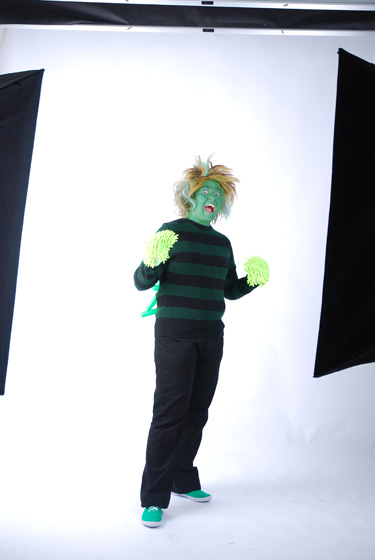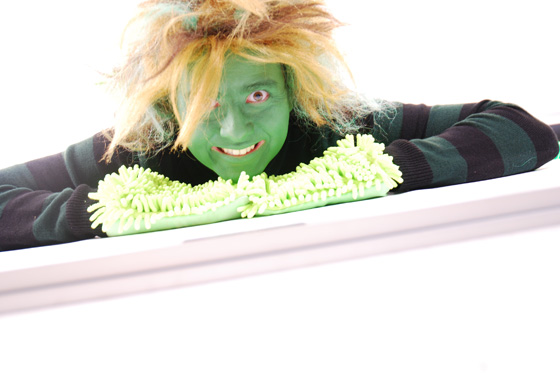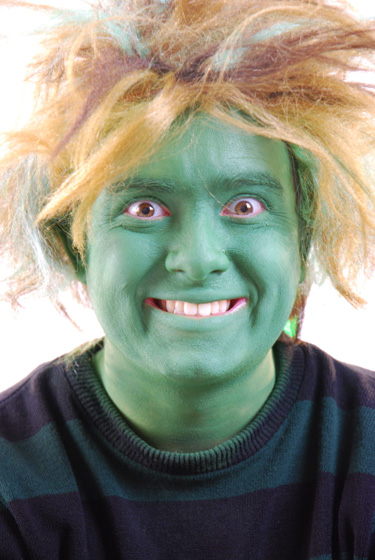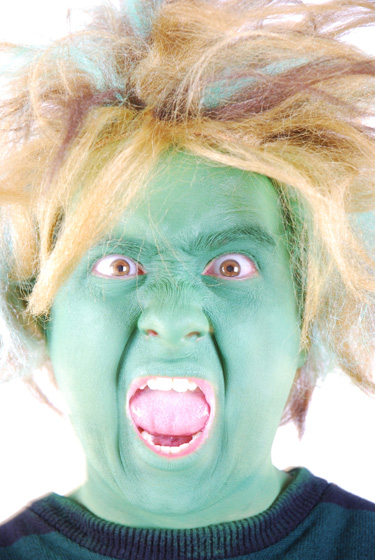

This is the final entry in Viral Man: The Making Of. After five posts and now this, the sixth, I hope that you’ve had an insight as to what I did to get to the final stages of the Viral Man project. In this entry, I’ll be talking about the filming for Viral Man and the impact that it’s made on the University as an institution, the students and the external press. Unfortunately, as I’ve said in previous posts, I did have photos to go with this post but lost them in my hard drive crash so again, I apologise!
Viral Man goes filming
On the last Monday of work, we set about making plans for filming Viral Man’s main interview video. This two minute video would introduce people to Viral Man, while the smaller 15 second videos would show how he could be found infecting people in any manner of ways from making them cough and sneeze, to giving them aches and pains.
I was becoming quite accustomed to being dressed as Viral Man now. You could even say I was enjoying it. Although it was nothing more than facepaint and a wig, it does make you feel very different knowing that people around you are looking at you in an entirely different way.
The previous week, Jerry, Will and Hannah had spent time developing a script for me to read through while I was concentrating on designing the poster campaign. I hadn’t had much chance to rehearse it until I got to see it on Monday morning. It wasn’t actually that much script for a two minute piece of video, but because there were to be pauses and cut-aways, it easily added up.
Hannah did my makeup and I got dressed as Viral Man once more and Will set the camera up in one of the unused ‘quiet rooms’ in the library. The room, while not soundproof, is indeed quiet and made an excellent fake office.
As mentioned in my previous entry, the committee had had some reservations over the type of voice that Viral Man would have and I hadn’t really come up with a new one as of yet. It meant that I had to try and come up with a voice as we were filming. I knew that I wanted him to sound ‘husky’ and as if Viral Man himself had the flu. But at the same time, he needed attitude and even a bit of anger. Anger at the world for not loving him!
I wrote the script out on A3 pieces of paper and Hannah held them as far back as possible while I read them. The trouble was that because I wear glasses and Viral Man most certainly doesn’t, I was blind for most of the time I was reading! It meant that the script couldn’t be too far away from my eyes. Ideally of course, it would have been better to memorise the script altogether, but we just didn’t have the time.
Having gone through a few test runs, it was clear that it looked as if I was reading from a script instead of looking at an interviewer off camera. Because of this, we ended up refilming the interview the next day.
This time, I had tried to refine the voice a little more and I had the advantage of knowing the script a little better. This time, I read the script in sections, pausing to memorise the next part. I was allowed to do this because as I said earlier, we’d be cutting away from the interview to various mini videos so it didn’t matter too much if the script wasn’t read in one go.
I had a lot of fun being filmed as Viral Man. It was the first time that Viral Man had had a chance to speak. In the mini videos, Viral Man only acted, never spoke. It was fun to give him a bit more depth and allow him a point of view.
On Tuesday we also met up with some of the members of the committee and showed them a rough cut of the interview to make sure they were happy with the voice and script. It was a bit of a backwards way to do things, filming everything and then getting approval, but it was the only way we could do things quickly, as we didn’t have much time left. Thankfully, they were happy with what we were doing.
Once all of the interview filming was complete, it was then up to Jerry to put everything together in Final Cut. And so here for your viewing, is the video for Viral Man:
The next day, we did some final filming for some of the short videos outside. It was funny watching people’s reactions as they wondered why they were watching a green man doing strange things.
Later that day, to help with the transition of handing over all of the campaign assets, I wrote a campaign manual for those who would be responsible for keeping it going and a character profile for anyone who would be playing Viral Man. I think it’s really important to make sure that people understand that the character has a very specific way of acting and to go against that would go against the project.
Saying goodbye to Viral Man
Wednesday ended up being my very last day as Viral Man and in a way, I was quite disappointed! I had become accustomed to going home half green so much so that I felt comfortable enough to even take a trip to Asda in full Viral Man costume (including green face and wig) just to see what sort of expressions we’d get. It was hilarious. People looked at me as if they hadn’t quite believed what they had just seen, while others burst out laughing. There were also a few children who were either incredibly curious or incredibly scared. It was a fun experience and once which I’ll miss being a part of.
On Thursday, my penultimate day of work, I took a trip over to Chester to get some test posters printed and handed them over to the committee, along with a few copies of the campaign manual and character profile.
The Last Day
Finally, on Friday, we took delivery of 2,500 spikey balls for the project, along with 2,500 stickers. This ended up being one of the most fun days of the project, mainly because all of the more challenging stuff was now out of the way. Instead, the morning was spent removing all of the packaging from the spikey balls so that it was easier to distribute them. We also cut A4 sheets of stickers down to A6 for easier handling. While Hannah, Will did that, Jerry focused on editing the rest of the videos for a 4pm deadline. As for myself, I had very little to do now that my job as Viral Man was complete! I had designed two poster campaigns, beer mats, stickers, set up a Facebook profile and YouTube account and of course been the character of Viral Man in person. It was weird to now be struggling to find something to do.
At 4pm, we managed to get everything burnt to disks and handed everything over to the committee. It felt great to have completed a project that we were all quite proud of. To go directly from being a student of the university to staff of the university and be repsonsible for creating a campaign that would affect 15,000 students sounded like a daunting task at first and yet for the five weeks that we worked on it, it turned out to be a hell of a lot of fun and a project which I’m proud to have been a part of.
And with all of that said, I’d like you to head over to the Viral Man project page and see everything that was designed as part of the project. I’d love your thoughts on it. You can also become a friend of Viral Man on Facebook at www.facebook.com/viralman.
Thank you for reading these posts and I hope that you’ve enjoyed them. It’s been useful for me to write them as well, as it’s great to look back over what I’ve done. There will be one more entry about Viral Man and this will be to do with presenting it to a total of 1,500 students – on my own!
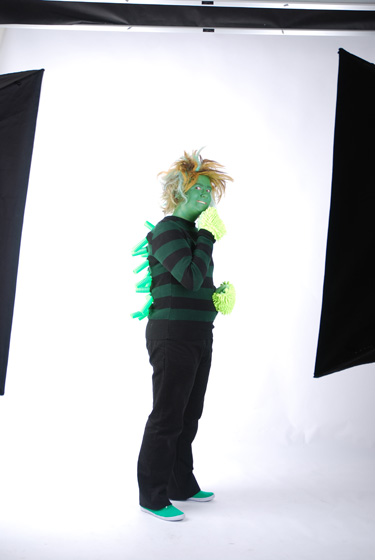
In the last entry, I wrote about how we had developed the campaign to the point where we were now in the studio, taking photos in preparation for the poster campaign. Unfortunately, having looked at them over the following weekend, I decided that they weren’t good enough to use and so on the following Monday, we went back to the studio.
Photoshoot Number 2
On our first trip to the studio, we had to set up ourselves and as I’ve already written, I’m not a photographer. We struggled along and did take some shots that were adequate, but none that stood out. Luckily on the second visit, we managed to find Mike Pumford, Kingsway’s technician who generously took a moment of his time to help us out and set the equipment up correctly and we started taking much better shots.
A few unaltered photos from our second photoshoot.
As you can see, these images proved to be much more professional, even at an unedited stage. We ended up taking a lot of photos. Some good, some bad. But there were quite a number of them that stood out.
A few unaltered photos from our second photoshoot.
In order to get people to pay attention to the posters, I felt that some tight closeups of his face were important. His costume was secondary. His green, over-exaggerated face was what would attract people to look at and read the posters.
Making Viral Man larger than life
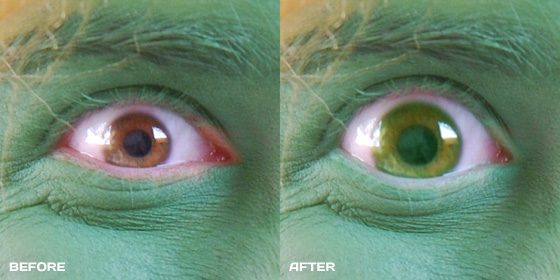
The next day, I began sifting through all of the photos we had taken. With three photos picked out, I set to work on making him larger than life. It was important that the character only resembled a normal person, rather than simply looking like a person with green facepaint. So, in order to do this, I started exaggerating his eyes to the point where there was no doubt that these eyes could never belong to a normal human being.
A digital makeup check and an exaggeration of the eyes.
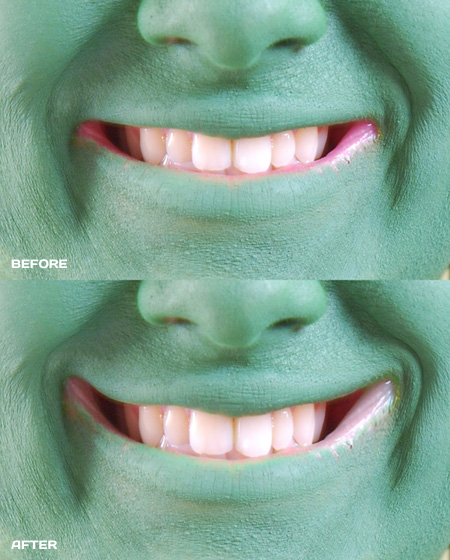
I started by performing a digital makeup check on the eyes, improving the coverage of the facepaint on the eyelids to the point where they looked much more naturally blended. Also, I have brown eyes and they looked out of place on such a green character so I changed the colour of them. Finally, I exaggerated the entire area of the eye to much larger proportions. Of course, the beauty of Photoshop is that you can do these modifications seamlessly and it did the trick. I also increased the size of the character’s nose and mouth, and did the same makeup checks on the lips, while digitally pulling the sides of the mouth up a little to make it look as if the character was grinning more than humanly possible.
A much less human grin.
The Logo
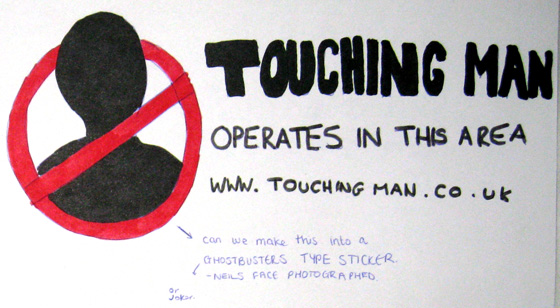
As I showed in an earlier entry, I wanted the character to have a logo of some sort. Something that would tie all of the various elements of the campaign together and I knew roughly what it should look like:
A logo to tie all elements of the campaign together.
Now that we had taken lots of photos, I had something to reference. It was important that it wasn’t just a generic silhouette like in my above sketch but adequately referenced the character. And of course the thing that stands out most about the character besides the fact that he’s green, is his hair. And so this is what I came up with:
You’ll notice that it says Viral Man, not Touching Man, as I’ve been referring to throughout these entries. And I’ll get onto that in a moment.
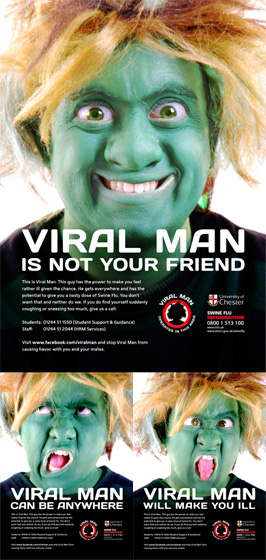
After designing the logo and writing the copy for the posters, I was very happy with how they looked. And here they are:
All three posters.
You can view larger versions in the project area, which will be going live within a week of this post.
The presentation
After four weeks of working on this project, surprisingly, we had still yet to actually show anything to the committee responsible for giving it the green light. We had wanted to keep it secret until a point at which we could properly present it i.e. The above posters and photoshoots.
On Wednesday, I spent the day designing a screen-based presentation which I was to deliver the next morning to introduce the committee to what we had so far. I travelled to Chester for an 8am start and set the presentation up in the meeting room. At 8:30am, everyone arrived and the reveal took place. I had designed the presentation to slowly describe why the character looked the way he looked by cropping various photos of him, starting at his green shoes and working all the way up to his face. At the final reveal of his face, everyone seemed to like it.
In addition to the reveal Touching Man’s face, I had also been practicing my voice for the character and recorded a basic example script so that the committee could get an understanding of how he would sound in videos. Have a listen.
Unfortunately, there were concerns about the voice sounding too much like a speech difficulty and because it was a university-produced campaign, they didn’t want to offend anyone. This was understandable and the voice was scrapped for something more recognisable and normal.
Overall however, everyone was really pleased with how the campaign had been developed so far and were looking forward to seeing the finalised videos.
One of the things that came up in the meeting was the creation of the website. I hadn’t been looking forward to designing the site as there wasn’t much time to do create it and a Flash website takes time. Luckily however, the c0mmittee expressed their interest in using social networking instead of a website because they were worried about maintaining the site. It meant that we could focus on building the Facebook profile and more time to film the videos.
One final thing that the committee asked for was a second poster campaign that ran with the government’s national campaign’s slogan of “Catch it, Kill it, Bin it”. This meant another trip to the studio on the same day, where Hannah and I spent the afternoon taking more photos.
Photoshoot number 3
Just before we went to the studio, we spent an hour looking for props to use in the three new posters, showing how the character could be caught, killed and binned. That meant buying a net, anti-bacterial gel and a large bin. Quite a strange shopping list.
The photoshoots are fun, but quite tiring. It’s much more than a case of just taking three photos and that’s it. It’s getting the right photo, with the right focus, lighting etc. And this takes a hell of a long time to do. We spent a long time getting shots to look right.
A friend came to help/watch us take more photos in the studio and literally provided a helping hand to hold some anti-bacterial gel to look as if he was killing me with it. I also took some shots of his arm on its own so that I could play around with it in Photoshop and add it to a photo of myself.
At the end of the day, we came away with nearly 300 photos. That night I started to develop the photos into posters.
The name change
The next day, I recieved a priority email alerting us to the fact that the committee had changed their mind about the name “Touching Man” as they felt it had too many negative connotations, especially for a university-led campaign. Instead, they asked if they could use “Viral Man”. This change came after I had already designed the posters, logo and set up the Facebook profile. Admittedly, the four of us responsible for running with the name (And telling the committee about it at an early stage) weren’t happy with the name change and I tried my best to persuade them to keep “Touching Man”. It wasn’t to be though and “Viral Man” was chosen as the new name.
In retrospect, it’s completely understandable. I think that because we had been working on it on our own for four weeks, we had become quite accustomed to the name, regardless of if it was suitable enough for the project. While “Viral Man” is a little more tame and obvious, “Touching Man” does indeed bring too many negative connotations and the name change was justified. And so Viral Man was born.
I made the required changes to the posters and logo and set up another Facebook profile, this time in the name of Viral Man. Luckily, the 2,500 stickers which had been designed for the campaign had not been printed yet and they needed to be changed to reflect the change of Facebook profile address.
And so the penultimate week was over and there were now two poster campaigns, a Facebook profile, stickers, a logo and a countless number of photos that had been taken over the course of three photoshoots. Next week would be all about filming and finally, signing, sealing and delivering the whole campaign to the university in preparation for its launch just a few weeks later.
In the final entry: Two days of filming, an interview with Viral Man and taking delivery of 2,500 spikey balls.
In the previous Making Of entry, I wrote about how we had come to rest on our chosen Swine Flu campaign – Touching Man. You’ll notice that I keep calling the campaign “Touching Man” and not “Viral Man”. There’s a reason for this, which will be explained further on. In this entry, I’ll be writing about our efforts to come up with a unique look for the character and how he’d appear in videos.
Mini videos
Through our research in the first week of the project, we discovered that there were seven or eight main symptoms for Swine Flu and we wanted people to see Touching Man giving his victims these symptoms as separate videos. So, we wanted a video for sneezing, one for coughing, headaches, tiredness and others. However, because the campaign was about defeating Touching Man, these videos on their own wouldn’t work. It would look like he was winning. To counterbalance we decided that an identical set of videos would be filmed but with a twist – The ending would be different to each one. Essentially, video A would show Touching Man winning, while video B would show him losing.
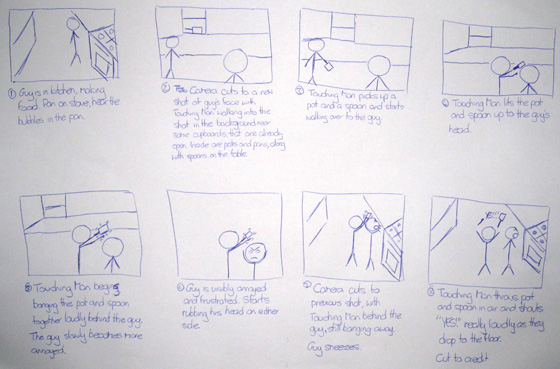
Storyboards for the short adverts.
My drawing skills aren’t the best, as you can see above, but Monday was spent developing a range of storyboards for all 12-14 videos that we wanted to produce. Because these would be in the style of adverts, we knew that they wouldn’t be more than 15 seconds long, which meant that we had to think of something suitable and funny that could be conveyed to the viewer in a small amount of time. Not only that, but we then had to think of an alternate ending for each one. Some of the videos proved difficult to think of endings for, while others seemed to make complete sense.
The frustrations of Flash
In addition to the videos, the committee had expressed their interest in developing a screensaver which could then be used on all University computers. We were really interested in doing this too but our downfall was that out of all four of us, none of us knew an extensive amount of ActionScript for Flash. Without this knowledge, the task of building a screensaver proved frustrating to say that least.
What we wanted was quite simple in theory. We wanted multiple spikey virus balls to continuously bounce off the edge of the screen and each other. We wanted to be able to set the speed, size and collision detection on each of the balls.
Because none of us knew much about ActionScript, we had to rely on finding and cannibalising various scripts found online, but none did quite as we wanted. Having no real experience with ActionScript, it proved to be a serious challenge. At times, we got close to a solution, but it just wasn’t quite polished enough to work. After two days of trying, I felt that it wasn’t worth carrying on and had to unfortunately scrap the idea.
The website
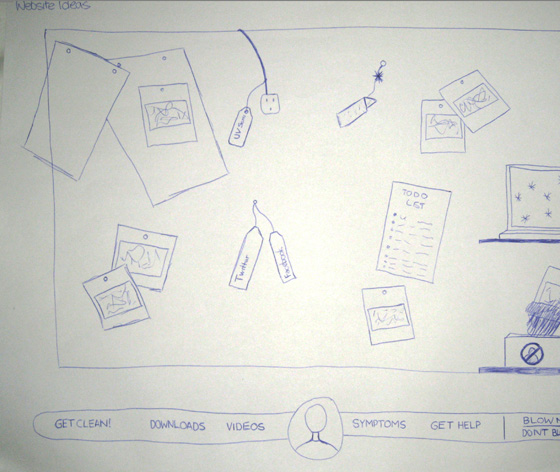
Part of the Touching Man campaign included a website to house all of the supporting elements such as a poster campaign and somewhere to house the short videos that we’d be filming. This would not only take up a lot of time on the project, but the responsibility of designing and coding it would have to fall to one person and one person only because it would be quite hard to work collaboratively on a site that was constantly being updated at two ends. I had already volunteered to take on the responsibility of designing the site and had also started a few sketches of what the site could look like.
Possible website to house all assets.
My Flash skills aren’t fantastic, as already described, but I knew that in order to attract people to it and actually use it, the site must be built in Flash. It needed lots of transitions and animation to help immerse the user in Touching Man’s world. However, because we didn’t actually have any content for the site yet, it meant that we couldn’t even start work on it until the last few days.
Speaking with the Archbishop of York, John Sentamu.
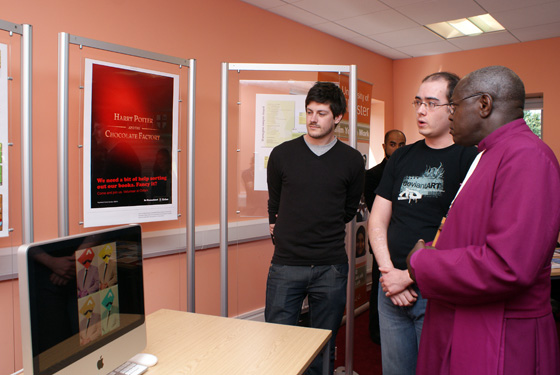
On July 30th, we stopped work on the campaign to help out with welcoming the Archbishop of York, John Sentamu to the university to open a new building. I’ve already written about that particular day here so I won’t write about it again, only to say that it was a pleasure meeting him as he was a really nice man.
Turning the spikey balls into a reality
From the outset of the campaign, we were really keen to have something physical that we could give to new students that would remind them about the campaign. Because the Swine Flu virus is shaped like a sphere with spikes, we thought this would make a great toy or keychain. We began to research into companies who offered anything along the lines of what we wanted, going so far as to open up real time conversations with suppliers in China via Alibaba. There were one or two companies that said they had what we needed, but because of the language barrier, I didn’t feel confident enough to place an order with them.
Instead, earlier research had found an American company that stocked exactly what we needed. Rhode Island Novelty offered a set of eight different coloured spikey ball keychains and after a few emails back and forth, we managed to work out a great bulk price for 2,500 of them – the number of new students that would be joining the university. They proved to be really helpful in supplying us what we wanted. The order was placed and would arrive within a few days, all the way from America. I do wonder if they’d had such a large order for keychains before!
Touching Man’s costume
The last thing we sorted out for the week was what Touching Man would be wearing for his costume. We had decided that he would definitely need some sort of spikes and that he would definitely be green. I personally had envisaged him with some sort of shell on his back and was really curious to see if we could find something that would fit that vision. So, with that in mind, we took a trip to the local Homebase!
We visited a number of shops including a gardening store, pet store and a general convenience store to find anything we could use to make the costume. In particular, we were looking for things to attach spikes to and indeed things to make spikes from.
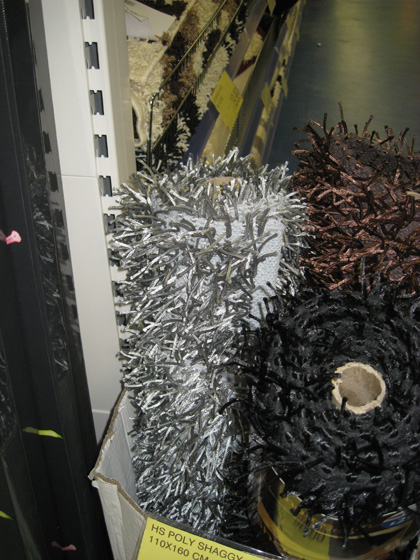
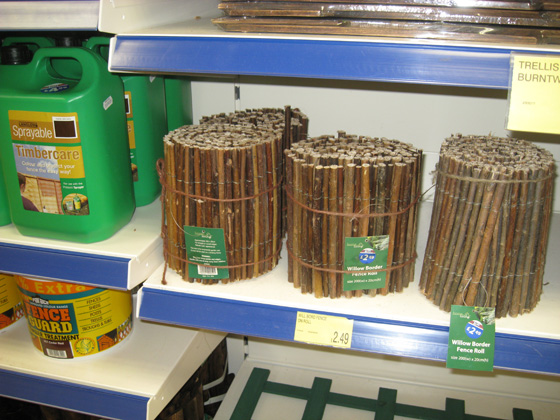
A few examples of spikey textures.
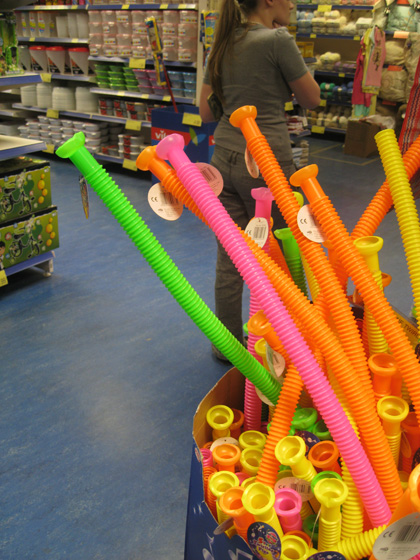
Our chosen spikes.
Above are just some of the things that we found. We had already set ourselves a budget of less than £100 to buy everything we needed for the costume (though we had a budget of three times that) and so using every day items and colourful toys like above proved to be a good cost-saving idea. Similarly, we also looked at these items too:
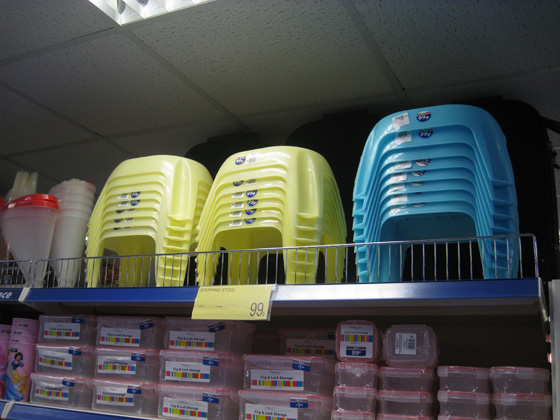
A possible shell for Touching Man's back.
More ideas for Touching Man's spikes.
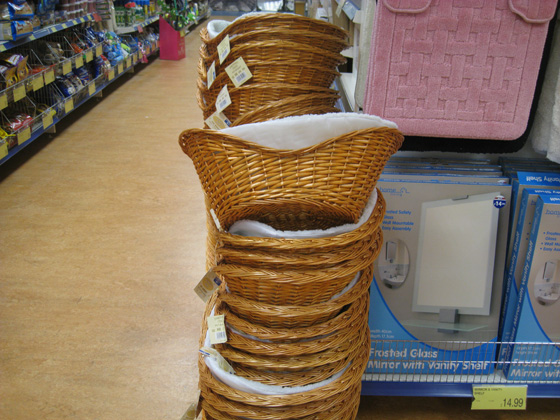
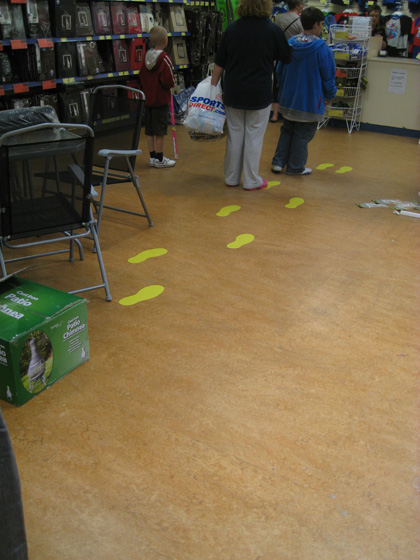
Interesting floor graphics.
Although I was quite intent on buying some sort of shell for Touching Man, most of the stuff that we found was either too heavy or simply not usable. Additionally, both Will and Jerry said that they didn’t feel a shell was necessary. After a lot of persuasion, I sided with them and decided against the shell idea, but we picked up 12 of the long, green, neon sticks that you can see above. It was quite funny taking them to the counter. I don’t think people buy these things in bulk.
In addition to the above things, we also took a trip to Hobbycraft to buy some green facepaint, pegs, spraypaint (to paint the pegs), green felt and lots of other green things in general. In just a few days, Touching Man would be making his first appearance…
In the next entry: The birth of Touching Man and his first public appearances.
One of the first videogames to be released to the public was Pong, a very simplistic version of table tennis. Produced by Atari and released in arcades in 1972, it was a first generation video game that also became one of the most popular of all time. First generation games were produced from 1972-1977, while today’s video games are considered to be seventh generation.
Al Alcorn, one of Atari’s first employees, was the engineer who constructed the first Pong arcade game. The game was named after the desired sound that Bushnell wanted incorporated in the game. The dictionary defines “pong” as a hollow, ringing sound, and this was the sound Bushnell felt was necessary in the game. (A Brief History of Video Games)
Pong would not be the same without the noise that accompanies it. It is perhaps more famous because it’s the only sound in the game. Scott Cohen, author of “Zap! The Rise and Fall of Atari” explains how this helped make the game more popular:
One of the regulars approached the Pong game inquisitively and studied the ball bouncing silently around the screen as if in a vacuum. A friend joined him. The instructions said: ‘Avoid missing ball for high score.’ One of [them] inserted a quarter. There was a beep. The game had begun…There was a beautifully resonant “pong” sound, and the ball bounced back to the other side of the screen…Seven quarters later they were having extended volleys, and the constant pong noise was attracting the curiosity of others at the bar. Before closing, everybody in the bar had played the game… Cohen, R. (1984) Zap: The Rise and Fall of Atari. Xlibris Corporation.
This single noise gave players an audible aid as to what was going on onscreen. Without this noise, there would be a vacuum, as Cohen writes. The sound adds a level of interaction that visuals alone cannot. It makes each hit of the ball feel more real. Although the visuals were nothing more than white blocks on a black screen, by adding a single sound, the overall dynamics are changed. The blocks are suddenly sturdier, with weight and depth. With this one sound, a user is able to create something in their mind that isn’t shown on screen, but is explicity implied via the sound. From here, it is easy to see how sound in video games progressed through to modern day games.